The C#7 chord (C sharp seventh) has 4 notes, C#, E#, G# and B. Its standard shape, x46464, is a barre chord, with your index finger across fret 4 from the A string to the high E string. It takes 3 fingers between frets 4 and 6. For a version with no barre, use x43404, which takes 4 fingers between frets 3 and 4. You'll also see it written Db7, and both names point to the same chord. The 7 stands for dominant seventh.
Shape codes list one symbol per string, from the 6th (low E) string to the 1st (high E) string. A number is the fret, 0 is an open string and x is a muted string. In the diagrams, numbers are fingers and the marked dot is the root.
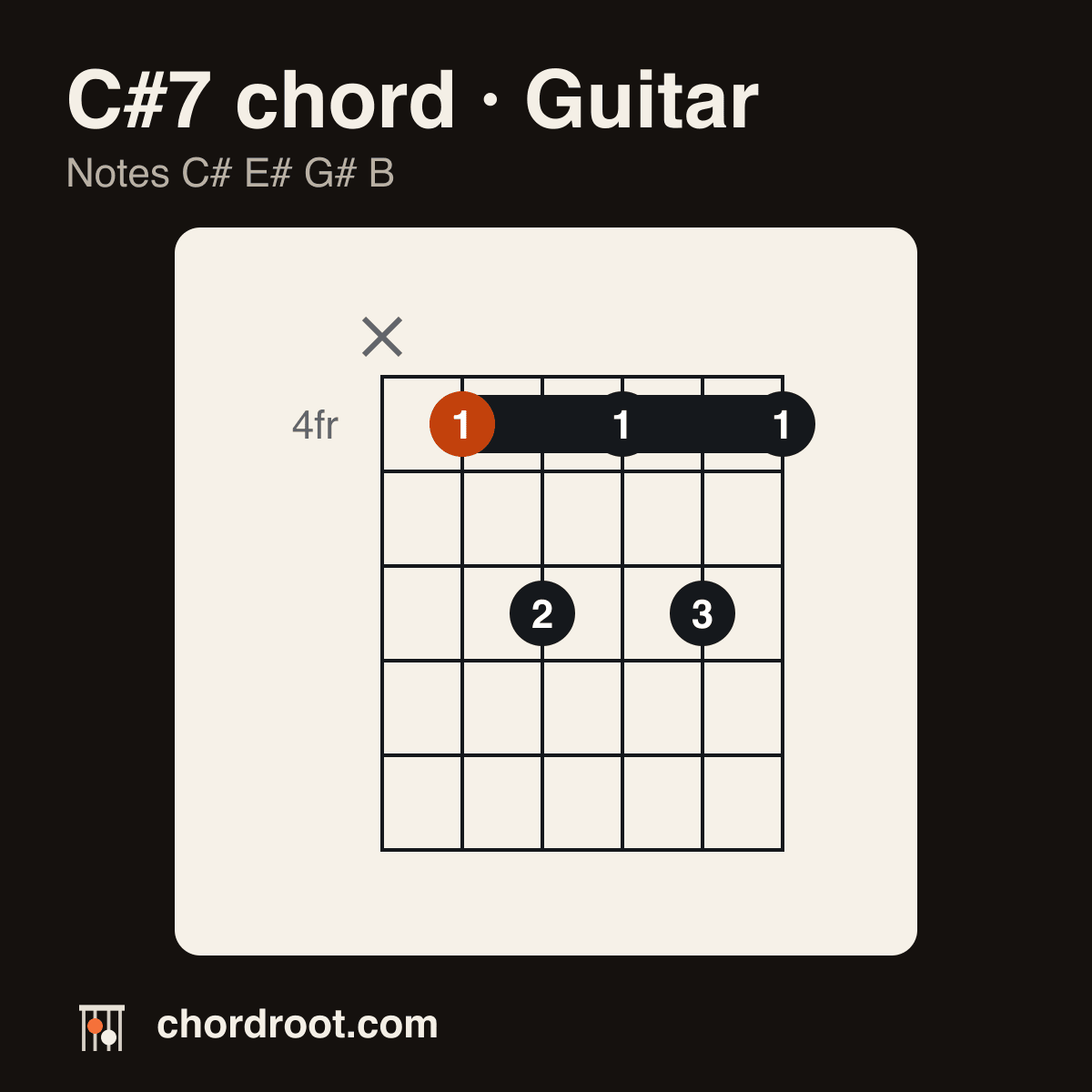
How to play the standard C#7 shape
Lay your index finger flat across fret 4, from the A string to the high E string. Leave out the low E string and start on the A string.
| Finger | String | Fret |
|---|---|---|
| index, barre | A to high E | 4 |
| middle | D | 6 |
| ring | B | 6 |
What C#7 sounds like
C#7 sounds bluesy and restless because of its major third (E#) and flat seventh (B). C#7 resolves to F#, its tonic, because C#7 is V7 in that key. A 12-bar blues can use dominant sevenths for its I, IV, and V chords.
3 ways to play C#7
C#7 has 3 shapes here, starting at frets 4, 3 and 9.
- Standardx46464low EmutedAC#DG#GBBE#high EG#
- No-barrex43404low EmutedAC#DE#GBBBhigh EG#
- 9-11-9-10-9-9low EC#AG#DBGE#BG#high EC#
You'll hear G# on the high E and D strings with x46464, because that shape uses both strings.
What's in C#7
The C#7 formula is 1 3 5 b7. The b7 lowers the seventh by a half step from C#maj7, making C#7 a dominant seventh.
| Note | Degree | Role | Half steps from the root |
|---|---|---|---|
| C# | 1 | root | 0 |
| E# | 3 | major third | 4 |
| G# | 5 | fifth | 7 |
| B | b7 | flat seventh | 10 |
Keys with C#7
The C#7 chord belongs to 1 major key and 1 minor key. Roman numerals give the chord's degree in each key, in upper case for major chords and lower case for minor ones.
| Key | Numeral | Function |
|---|---|---|
| F# major | V7 | 5th degree, dominant |
| Eb minor | VII7 | 7th degree |
In F# major, C#7 goes with F#, G#m, A#m, B and D#m. A common progression is I7, I7, I7, I7, IV7, IV7, I7, I7, V7, IV7, I7, V7, played as F#7, F#7, F#7, F#7, B7, B7, F#7, F#7, C#7, B7, F#7 and C#7.
Questions about C#7
- Is C#7 hard to play on guitar?
- Yes. It's one of the harder 7th chords, number 10 of 12.
Songs that use C#7
One song on the site uses C#7.
- Beneath The Cross Of Jesuskey of Db, one of its main chords, appears 10 times, in every verse
Compare C#7 with other chords
9 chords share the C# root and 11 chords are other 7th chords. The table runs from the smallest hand movement to the largest, starting from x46464. See all 7th chords.
| Chord | Relation | Shapes | Hand movement |
|---|---|---|---|
| C# | Same root, drops B | x46464 to x46664 | 2 fingers stay · index finger on A string at fret 4 · middle finger on D string at fret 6 |
| C#sus2 | Same root, drops E# and B and adds D# | x46464 to x46644 | 2 fingers stay · index finger on A string at fret 4 · middle finger on D string at fret 6 |
| C#m | Same root, drops E# and B and adds E | x46464 to x46654 | 1 finger stays · index finger on A string at fret 4 |
| C#aug | Same root, drops G# and B and adds G## | x46464 to xxx665 | 1 finger stays · ring finger on B string at fret 6 |
| Ab7 | Same quality, root down 5 half steps | x46464 to 464544 | 1 finger stays · index finger on high E string at fret 4 |
| F#7 | Same quality, root up 5 half steps | x43404 to 242322 | no finger stays · each finger moves at most 1 fret |
| C#maj7 | Same root, drops B and adds B# | x43404 to x43111 | no finger stays · each finger moves at most 2 frets |
| C#m7 | Same root, drops E# and adds E | x43404 to x42100 | no finger stays · each finger moves at most 2 frets |
| C#add9 | Same root, drops B and adds D# | x43404 to x41121 | no finger stays · each finger moves at most 2 frets |
| C#dim | Same root, drops E#, G# and B and adds E and G | x43404 to x42020 | no finger stays · each finger moves at most 2 frets |
| C7 | Same quality, root down 1 half step | x43404 to x32310 | no finger stays · each finger moves down at most 2 frets |
| D7 | Same quality, root up 1 half step | x43404 to xx0212 | no finger stays · each finger moves down at most 2 frets |
| Eb7 | Same quality, root up 2 half steps | x46464 to x68686 | no finger stays · slide the whole shape up 2 frets |
| E7 | Same quality, root up 3 half steps | x43404 to 020100 | no finger stays · each finger moves down at most 2 frets |
| F7 | Same quality, root up 4 half steps | x43404 to 131211 | no finger stays · each finger moves down at most 2 frets |
| G7 | Same quality, root up 6 half steps | x43404 to 320001 | no finger stays · each finger moves down at most 2 frets |
| A7 | Same quality, root down 4 half steps | x43404 to x02020 | no finger stays · each finger moves down at most 2 frets |
| Bb7 | Same quality, root down 3 half steps | x43404 to x13131 | no finger stays · each finger moves down at most 2 frets |
| B7 | Same quality, root down 2 half steps | x43404 to x21202 | no finger stays · slide the whole shape down 2 frets |
| C#sus4 | Same root, drops E# and B and adds F# | x46464 to 9-11-11-11-9-9 | no finger stays · each finger moves up at most 5 frets |
C#7 on other instruments
The 4 notes, C#, E#, G# and B, stay the same on every instrument, but the shapes change.