The Bm chord (B minor) has 3 notes, B, D and F#. Its easiest shape, x20402, needs no barre. It takes 3 fingers between frets 2 and 4. You'll also see it written Bmin or B-, and all three names mean the same 3 notes. The m stands for minor.
Shape codes list one symbol per string, from the 6th (low E) string to the 1st (high E) string. A number is the fret, 0 is an open string and x is a muted string. In the diagrams, numbers are fingers and the marked dot is the root.
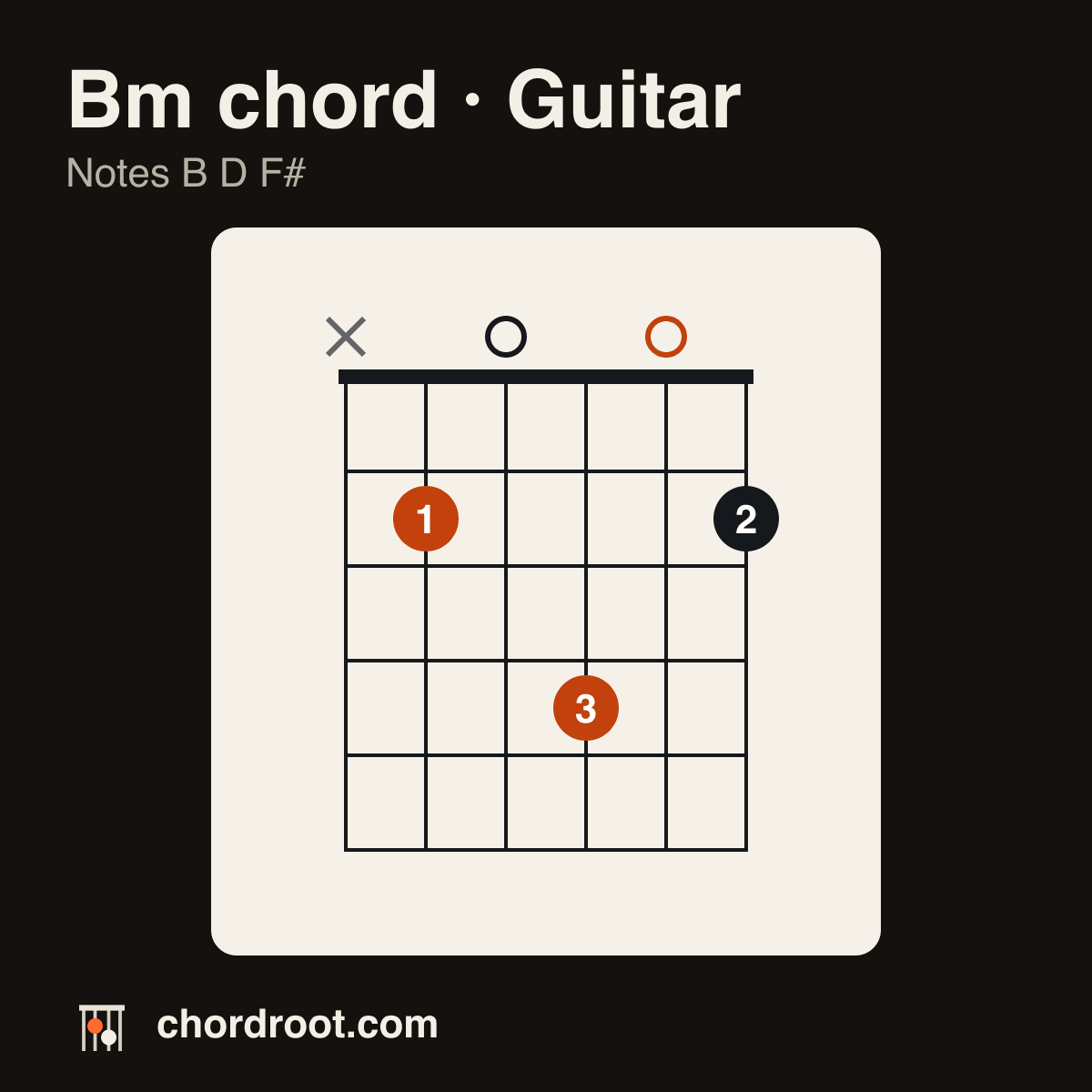
How to play the easiest Bm shape
Leave out the low E string and start on the A string. The D and B strings ring open.
| Finger | String | Fret |
|---|---|---|
| index | A | 2 |
| middle | high E | 2 |
| ring | G | 4 |
What Bm sounds like
Bm sounds darker and sadder than B major because of its minor third (D).
It's the home chord of the key of B minor. In D major, it's the vi chord, the one that gives many pop progressions their lift.
3 ways to play Bm
Bm has 3 shapes here, starting at frets 2, 2 and 7.
- Standardx24432low EmutedABDF#GBBDhigh EF#
- Easiestx20402low EmutedABDDGBBBhigh EF#
- 799777low EBAF#DBGDBF#high EB
You'll hear B on the G and A strings with x24432, because that shape uses both strings.
Easiest changes from Bm
You can begin with Bm to D, since 1 finger stays in place. The next close change is G, with 1 finger staying put. For Bm to A, you won't keep any fingers in place.
Try the smaller changes first, then play A, whose widest single finger movement spans 2 frets.
| Chord change | Shape or inversion | What moves |
|---|---|---|
Bm to D | Bm x20402 to D xx0232 | 1 finger stays · middle finger on high E string at fret 2 |
Bm to G | Bm x24432 to G 320003 | 1 finger stays · index finger on A string at fret 2 |
Bm to A | Bm x20402 to A x02220 | no finger stays · each finger moves at most 2 frets |
What's in Bm
The Bm formula is 1 b3 5. The b3 lowers the third by a half step from B major, making Bm minor.
| Note | Degree | Role | Half steps from the root |
|---|---|---|---|
| B | 1 | root | 0 |
| D | b3 | minor third | 3 |
| F# | 5 | fifth | 7 |
Keys with Bm
The Bm chord belongs to 3 major keys and 3 minor keys. Roman numerals give the chord's degree in each key, in upper case for major chords and lower case for minor ones.
| Key | Numeral | Function |
|---|---|---|
| D major | vi | 6th degree |
| G major | iii | 3rd degree |
| A major | ii | 2nd degree |
| E minor | v | 5th degree, dominant |
| F# minor | iv | 4th degree, subdominant |
| B minor | i | 1st degree, tonic |
In B minor, Bm goes with D, Em, F#m, G and A. A common progression is i, iv, v, played as Bm, Em and F#m.
Questions about Bm
- Is Bm hard to play on guitar?
- No. It's number 4 of the 12 minor chords on guitar, counting from the easiest.
Songs that use Bm
26 songs on the site use Bm, with the best known first.
- O Come O Come Emmanuelkey of Em, appears 5 times, in every verse
- Holy, Holy, Holykey of D, appears 8 times, in every verse
- Praise To The Lord, The Almightykey of G, one of its main chords, appears 10 times, in every verse
- All Hail The Power Of Jesus' Namekey of G, appears 14 times, in verses 1 to 7
- Immortal, Invisible, God Only Wisekey of G, appears 5 times, in every verse
- My Faith Looks Up To Theekey of D, one of its main chords, appears 4 times, in every verse
- Christ Returnethkey of D, appears 4 times, in every verse
- From Heaven Above To Earth I Comekey of D, one of its main chords, appears 33 times, in verses 1, 2, 3, 4, 5, 6, 8, 10, 12, 13 and 14
See all the Christmas carols and hymns.
Compare Bm with other chords
9 chords share the B root and 11 chords are other minor chords. The table runs from the smallest hand movement to the largest, starting from x20402. See all minor chords.
| Chord | Relation | Shapes | Hand movement |
|---|---|---|---|
| B | Same root, drops D and adds D# | x20402 to x24442 | 2 fingers stay · index finger on A string at fret 2 · ring finger on G string at fret 4 |
| Bsus4 | Same root, drops D and adds E | x20402 to x24400 | 2 fingers stay · index finger on A string at fret 2 · ring finger on G string at fret 4 |
| Em | Same quality, root up 5 half steps | x20402 to 022000 | 1 finger stays · index finger on A string at fret 2 |
| Bsus2 | Same root, drops D and adds C# | x24432 to x24422 | 1 finger stays · index finger on A string at fret 2 |
| Bdim | Same root, drops F# and adds F | x20402 to x20401 | 1 finger stays · ring finger on G string at fret 4 |
| F#m | Same quality, root down 5 half steps | x24432 to 244222 | 1 finger stays · index finger on high E string at fret 2 |
| Bm7 | Same root, adds A | x20402 to x20202 | 1 finger stays · index finger on A string at fret 2 |
| Baug | Same root, drops D and F# and adds D# and F## | x20402 to x21003 | no finger stays · each finger moves at most 1 fret |
| Cm | Same quality, root up 1 half step | x24432 to x35543 | no finger stays · slide the whole shape up 1 fret |
| Dm | Same quality, root up 3 half steps | x20402 to xx0231 | no finger stays · each finger moves at most 1 fret |
| Fm | Same quality, root up 6 half steps | x24432 to 133111 | no finger stays · each finger moves at most 1 fret |
| Bbm | Same quality, root down 1 half step | x20402 to x13321 | no finger stays · each finger moves at most 1 fret |
| B7 | Same root, drops D and adds D# and A | x20402 to x21202 | no finger stays · each finger moves at most 2 frets |
| Bmaj7 | Same root, drops D and adds D# and A# | x20402 to x21302 | no finger stays · each finger moves at most 2 frets |
| Gm | Same quality, root down 4 half steps | x24432 to 355333 | no finger stays · each finger moves up at most 2 frets |
| Am | Same quality, root down 2 half steps | x20402 to x02210 | no finger stays · each finger moves at most 2 frets |
| C#m | Same quality, root up 2 half steps | x20402 to x46654 | no finger stays · each finger moves up at most 3 frets |
| Abm | Same quality, root down 3 half steps | x24432 to 466444 | no finger stays · each finger moves up at most 3 frets |
| Badd9 | Same root, drops D and adds D# and C# | x24432 to 744447 | no finger stays · each finger moves up at most 4 frets |
| Ebm | Same quality, root up 4 half steps | x20402 to x68876 | no finger stays · each finger moves up at most 5 frets |
Bm on other instruments
The 3 notes, B, D and F#, stay the same on every instrument, but the shapes change.
What to learn after Bm
Learn D next.
1 finger stays in place as you switch from Bm to D. Bm is also the relative minor of D, with the same key signature.
After that, try G, then A.