The B chord (B major) has 3 notes, B, D# and F#. Its standard shape, x24442, is a barre chord, with your index finger across fret 2 from the A string to the high E string. It takes 4 fingers between frets 2 and 4. For a version with no barre, use x21402, which takes 4 fingers between frets 1 and 4.
Shape codes list one symbol per string, from the 6th (low E) string to the 1st (high E) string. A number is the fret, 0 is an open string and x is a muted string. In the diagrams, numbers are fingers and the marked dot is the root.
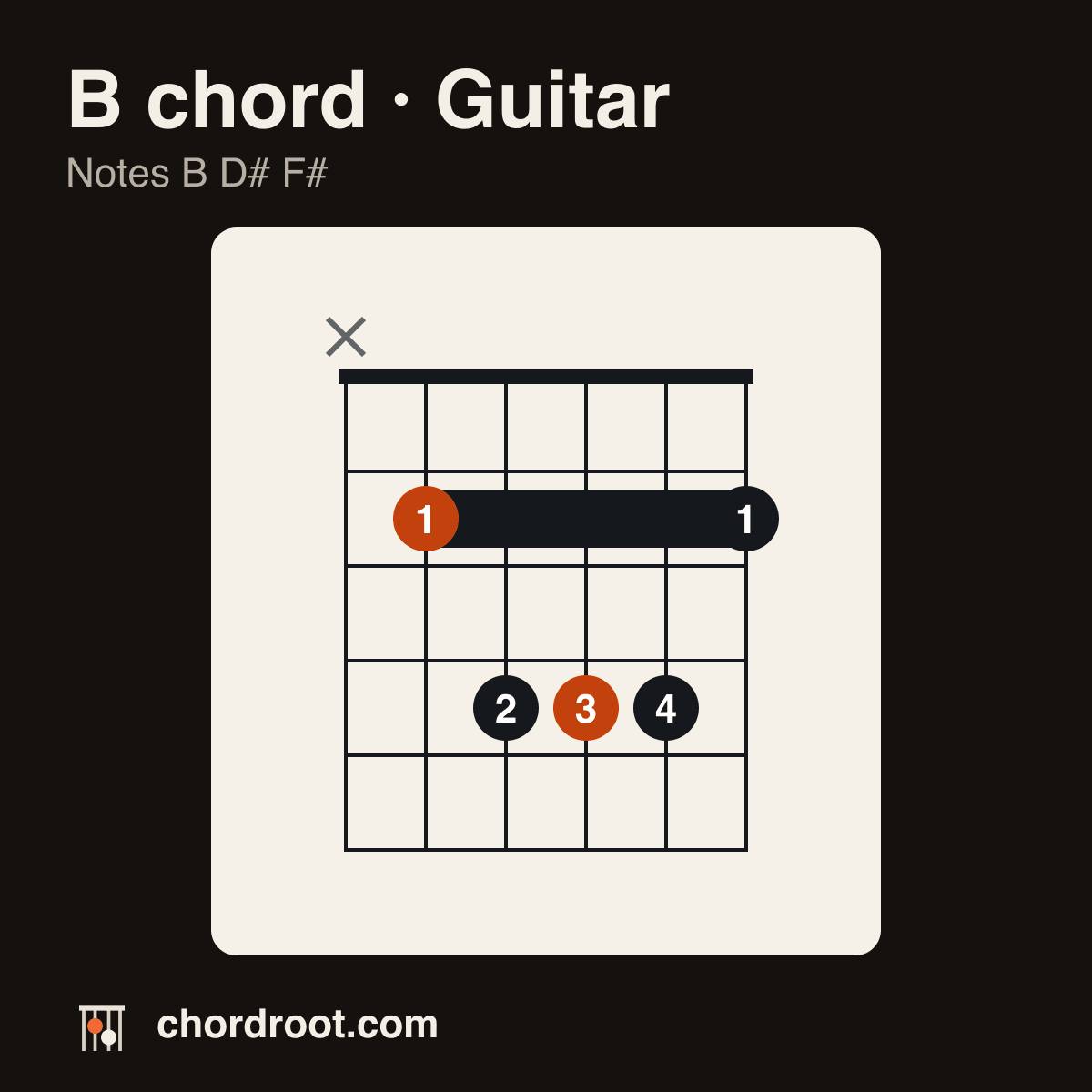
How to play the standard B shape
Lay your index finger flat across fret 2, from the A string to the high E string. Leave out the low E string and start on the A string.
| Finger | String | Fret |
|---|---|---|
| index, barre | A to high E | 2 |
| middle | D | 4 |
| ring | G | 4 |
| little | B | 4 |
What B sounds like
B sounds bright and stable because of its major third (D#).
It's the home chord of the key of B major. In its relative minor, G#m, it's the III chord.
4 ways to play B
B has 4 shapes here, starting at frets 2, 1, 7 and 11.
- Standardx24442low EmutedABDF#GBBD#high EF#
- No-barrex21402low EmutedABDD#GBBBhigh EF#
- 799877low EBAF#DBGD#BF#high EB
- x-14-13-11-12-11low EmutedABDD#GF#BBhigh ED#
You'll hear B on the G and A strings with x24442, because that shape uses both strings.
Easiest changes from B
Move from B to F# first. 1 finger stays in place, and A keeps no fingers there. For B to E, you won't keep any fingers in place.
Try the smaller changes first, then play A, whose widest single finger movement spans 2 frets.
| Chord change | Shape or inversion | What moves |
|---|---|---|
B to E | B x24442 to E 022100 | no finger stays · each finger moves down at most 2 frets |
B to F# | B x24442 to F# 244322 | 1 finger stays · index finger on high E string at fret 2 |
B to A | B x24442 to A x02220 | no finger stays · each finger moves at most 2 frets |
B to C#m | B x24442 to C#m x46654 | no finger stays · each finger moves up at most 2 frets |
B to C# | B x24442 to C# x46664 | no finger stays · slide the whole shape up 2 frets |
What's in B
The B formula is 1 3 5.
| Note | Degree | Role | Half steps from the root |
|---|---|---|---|
| B | 1 | root | 0 |
| D# | 3 | major third | 4 |
| F# | 5 | fifth | 7 |
Keys with B
The B chord belongs to 3 major keys and 3 minor keys. Roman numerals give the chord's degree in each key, in upper case for major chords and lower case for minor ones.
| Key | Numeral | Function |
|---|---|---|
| E major | V | 5th degree, dominant |
| F# major | IV | 4th degree, subdominant |
| B major | I | 1st degree, tonic |
| C# minor | VII | 7th degree |
| Eb minor | VI | 6th degree |
| G# minor | III | 3rd degree |
In B major, B goes with C#m, D#m, E, F# and G#m. A common progression is I, V, vi, IV, played as B, F#, G#m and E.
Questions about B
- Is B hard to play on guitar?
- It's in the middle, number 8 of the 12 major chords on guitar.
Songs that use B
10 songs on the site use B, with the best known first.
- Jingle Bellskey of E, one of its main chords, appears 11 times, in verses 1 and 2
- God Rest Ye Merry Gentlemenkey of Em, one of its main chords, appears 20 times, in every verse
- Were You There?key of E, one of its main chords, appears 12 times, in every verse
- God the Father Be Our Staykey of D, appears 8 times, in every verse
- Jesus, Thy Boundless Love To Mekey of E, one of its main chords, appears 15 times, in every verse
- The Strife Is O'er, The Battle Donekey of E, one of its main chords, appears 30 times, in every verse
- Tis Good, Lord, To Be Herekey of E, one of its main chords, appears 30 times, in every verse
- Today Thy Mercy Calls Mekey of A, appears 4 times, in every verse
See all the Christmas carols and hymns.
Compare B with other chords
9 chords share the B root and 11 chords are other major chords. The table runs from the smallest hand movement to the largest, starting from x24442. See all major chords.
| Chord | Relation | Shapes | Hand movement |
|---|---|---|---|
| Bsus4 | Same root, drops D# and adds E | x24442 to x24400 | 3 fingers stay · index finger on A string at fret 2 · middle finger on D string at fret 4 · ring finger on G string at fret 4 |
| Bsus2 | Same root, drops D# and adds C# | x24442 to x24422 | 2 fingers stay · index finger on A string at fret 2 · middle finger on D string at fret 4 |
| Bm | Same root, drops D# and adds D | x24442 to x20402 | 2 fingers stay · index finger on A string at fret 2 · ring finger on G string at fret 4 |
| F# | Same quality, root down 5 half steps | x24442 to 244322 | 1 finger stays · index finger on high E string at fret 2 |
| G | Same quality, root down 4 half steps | x24442 to 320003 | 1 finger stays · index finger on A string at fret 2 |
| Bm7 | Same root, drops D# and adds D and A | x24442 to x20202 | 1 finger stays · index finger on A string at fret 2 |
| Bdim | Same root, drops D# and F# and adds D and F | x24442 to x20401 | 1 finger stays · ring finger on G string at fret 4 |
| Bb | Same quality, root down 1 half step | x24442 to x13331 | no finger stays · slide the whole shape down 1 fret |
| B7 | Same root, adds A | x24442 to x21202 | no finger stays · each finger moves down at most 2 frets |
| Bmaj7 | Same root, adds A# | x24442 to x21302 | no finger stays · each finger moves down at most 2 frets |
| Baug | Same root, drops F# and adds F## | x24442 to x21003 | no finger stays · each finger moves down at most 2 frets |
| C | Same quality, root up 1 half step | x24442 to x32010 | no finger stays · each finger moves down at most 2 frets |
| C# | Same quality, root up 2 half steps | x24442 to x46664 | no finger stays · slide the whole shape up 2 frets |
| D | Same quality, root up 3 half steps | x24442 to xx0232 | no finger stays · each finger moves at most 2 frets |
| E | Same quality, root up 5 half steps | x24442 to 022100 | no finger stays · each finger moves down at most 2 frets |
| F | Same quality, root up 6 half steps | x24442 to 133211 | no finger stays · each finger moves down at most 2 frets |
| Ab | Same quality, root down 3 half steps | x24442 to 466544 | no finger stays · each finger moves up at most 2 frets |
| A | Same quality, root down 2 half steps | x24442 to x02220 | no finger stays · each finger moves at most 2 frets |
| Badd9 | Same root, adds C# | x24442 to 744447 | no finger stays · each finger moves up at most 3 frets |
| Eb | Same quality, root up 4 half steps | x24442 to x68886 | no finger stays · slide the whole shape up 4 frets |
B on other instruments
The 3 notes, B, D# and F#, stay the same on every instrument, but the shapes change.
What to learn after B
Learn E next.
No finger stays in place as you switch from B to E. B is also the relative major of G#m, with the same key signature.
After that, try F#, then A.