The F#maj7 chord (F sharp major seventh) has 4 notes, F#, A#, C# and E#. Its standard shape, 243322, is a barre chord, with your index finger across fret 2 from the low E string to the high E string. It takes 3 fingers between frets 2 and 4. For a version with no barre, use xx4666, which takes 4 fingers between frets 4 and 6. You'll also see it written F#M7, F#Δ7 or Gbmaj7, and all four names point to the same chord. The maj7 suffix means major seventh.
Shape codes list one symbol per string, from the 6th (low E) string to the 1st (high E) string. A number is the fret and x is a muted string. In the diagrams, numbers are fingers and the marked dot is the root.
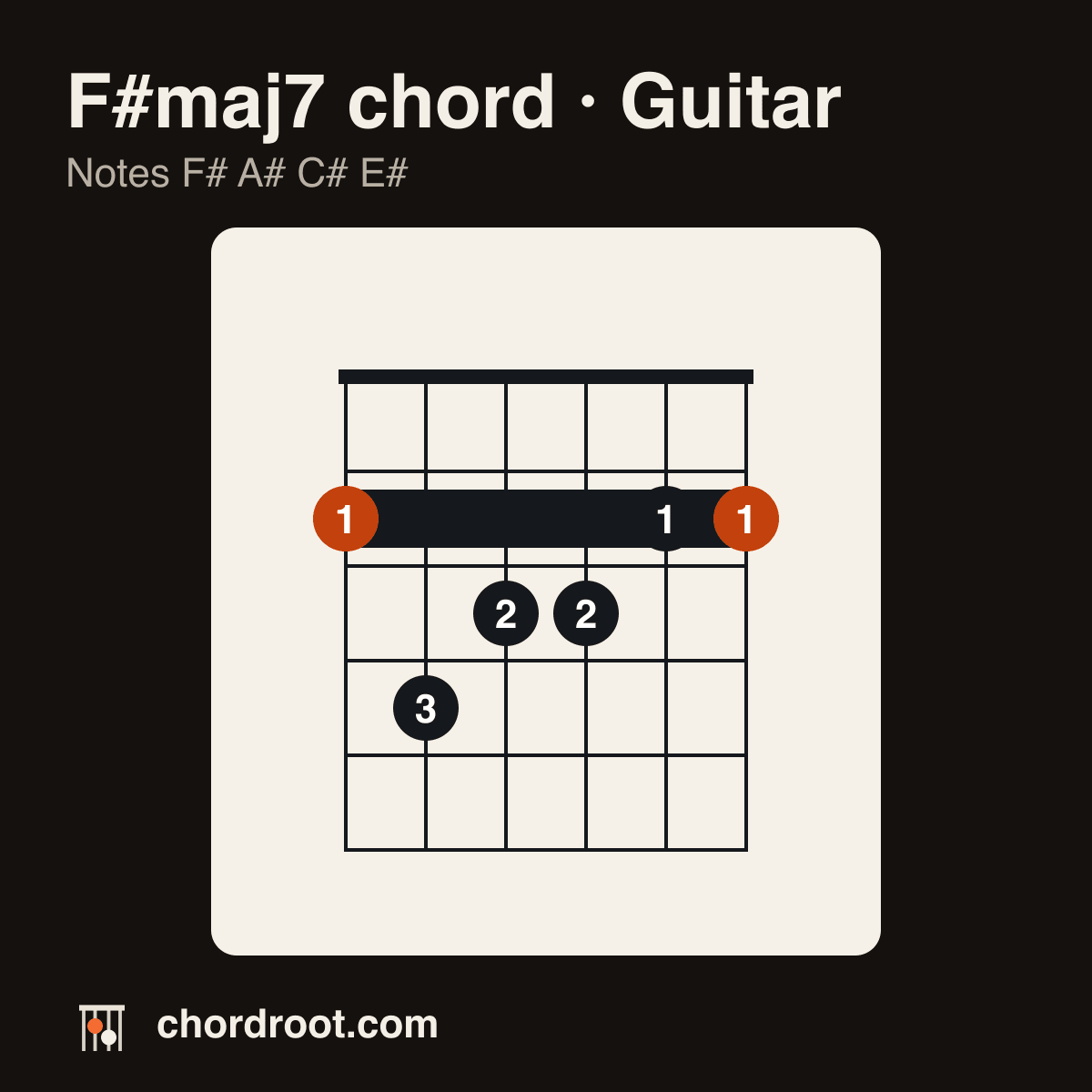
How to play the standard F#maj7 shape
Lay your index finger flat across fret 2, from the low E string to the high E string.
| Finger | String | Fret |
|---|---|---|
| index, barre | low E to high E | 2 |
| middle | D | 3 |
| middle | G | 3 |
| ring | A | 4 |
What F#maj7 sounds like
F#maj7 sounds soft and jazzy because of its major third (A#) and major seventh (E#). Jazz, bossa nova, soul and slow pop use it in place of a plain I or IV chord.
4 ways to play F#maj7
F#maj7 has 4 shapes here, starting at frets 2, 4, 9 and 13.
- Standard243322low EF#AC#DE#GA#BC#high EF#
- No-barrexx4666low EmutedAmutedDF#GC#BE#high EA#
- x-9-11-10-11-9low EmutedAF#DC#GE#BA#high EC#
- 14-13-15-15-14-13low EF#AA#DE#GA#BC#high EE#
You'll hear C# on the B and A strings with 243322, because that shape uses both strings.
What's in F#maj7
The F#maj7 formula is 1 3 5 7.
| Note | Degree | Role | Half steps from the root |
|---|---|---|---|
| F# | 1 | root | 0 |
| A# | 3 | major third | 4 |
| C# | 5 | fifth | 7 |
| E# | 7 | major seventh | 11 |
Keys with F#maj7
The F#maj7 chord belongs to 2 major keys and 2 minor keys. Roman numerals give the chord's degree in each key, in upper case for major chords and lower case for minor ones.
| Key | Numeral | Function |
|---|---|---|
| Db major | IVmaj7 | 4th degree, subdominant |
| F# major | Imaj7 | 1st degree, tonic |
| Eb minor | IIImaj7 | 3rd degree |
| Bb minor | VImaj7 | 6th degree |
In F# major, F#maj7 goes with G#m, A#m, B, C# and D#m.
Questions about F#maj7
- Is F#maj7 hard to play on guitar?
- Yes. It's one of the harder major 7th chords, number 10 of 12.
Songs that use F#maj7
One song on the site uses F#maj7.
- Under His Wingskey of Db, one of its main chords, appears 3 times, in every verse
Compare F#maj7 with other chords
9 chords share the F# root and 11 chords are other major 7th chords. The table runs from the smallest hand movement to the largest, starting from 243322. See all major 7th chords.
| Chord | Relation | Shapes | Hand movement |
|---|---|---|---|
| F# | Same root, drops E# | 243322 to 244322 | 3 fingers stay · index finger on low E string at fret 2 · middle finger on G string at fret 3 · ring finger on A string at fret 4 |
| F#7 | Same root, drops E# and adds E | 243322 to 242322 | 3 fingers stay · index finger on low E string at fret 2 · middle finger on G string at fret 3 · ring finger on A string at fret 4 |
| F#add9 | Same root, drops E# and adds G# | 243322 to 244324 | 3 fingers stay · index finger on low E string at fret 2 · middle finger on G string at fret 3 · ring finger on A string at fret 4 |
| F#aug | Same root, drops C# and E# and adds C## | 243322 to 254332 | 2 fingers stay · index finger on low E string at fret 2 · middle finger on G string at fret 3 |
| C#maj7 | Same quality, root down 5 half steps | 243322 to x43111 | 2 fingers stay · middle finger on D string at fret 3 · ring finger on A string at fret 4 |
| F#m | Same root, drops A# and E# and adds A | 243322 to 244222 | 1 finger stays · index finger on low E string at fret 2 |
| F#m7 | Same root, drops A# and E# and adds A and E | 243322 to 242222 | 1 finger stays · index finger on low E string at fret 2 |
| F#sus4 | Same root, drops A# and E# and adds B | 243322 to 224422 | 1 finger stays · index finger on low E string at fret 2 |
| Ebmaj7 | Same quality, root down 3 half steps | 243322 to xx1333 | 1 finger stays · middle finger on G string at fret 3 |
| F#sus2 | Same root, drops A# and E# and adds G# | 243322 to 246622 | 1 finger stays · index finger on low E string at fret 2 |
| Cmaj7 | Same quality, root up 6 half steps | 243322 to x32000 | no finger stays · same fret numbers, different strings |
| Fmaj7 | Same quality, root down 1 half step | 243322 to 132210 | no finger stays · slide the whole shape down 1 fret |
| Gmaj7 | Same quality, root up 1 half step | 243322 to 320002 | no finger stays · each finger moves at most 1 fret |
| F#dim | Same root, drops A#, C# and E# and adds A and C | 243322 to xx4212 | no finger stays · each finger moves down at most 2 frets |
| Dmaj7 | Same quality, root down 4 half steps | 243322 to xx0222 | no finger stays · each finger moves at most 2 frets |
| Emaj7 | Same quality, root down 2 half steps | 243322 to 021100 | no finger stays · each finger moves down at most 2 frets |
| Abmaj7 | Same quality, root up 2 half steps | 243322 to 465544 | no finger stays · slide the whole shape up 2 frets |
| Amaj7 | Same quality, root up 3 half steps | 243322 to x02120 | no finger stays · each finger moves down at most 2 frets |
| Bbmaj7 | Same quality, root up 4 half steps | 243322 to x10231 | no finger stays · each finger moves down at most 2 frets |
| Bmaj7 | Same quality, root up 5 half steps | 243322 to x21302 | no finger stays · each finger moves down at most 2 frets |
F#maj7 on other instruments
The 4 notes, F#, A#, C# and E#, stay the same on every instrument, but the shapes change.