The F# chord (F sharp major) has 3 notes, F#, A# and C#. Its standard shape, 244322, is a barre chord, with your index finger across fret 2 from the low E string to the high E string. It takes 4 fingers between frets 2 and 4. For a version with no barre, use xx4322, which takes 4 fingers between frets 2 and 4. You'll also see it written Gb, and both names point to the same chord.
Shape codes list one symbol per string, from the 6th (low E) string to the 1st (high E) string. A number is the fret and x is a muted string. In the diagrams, numbers are fingers and the marked dot is the root.
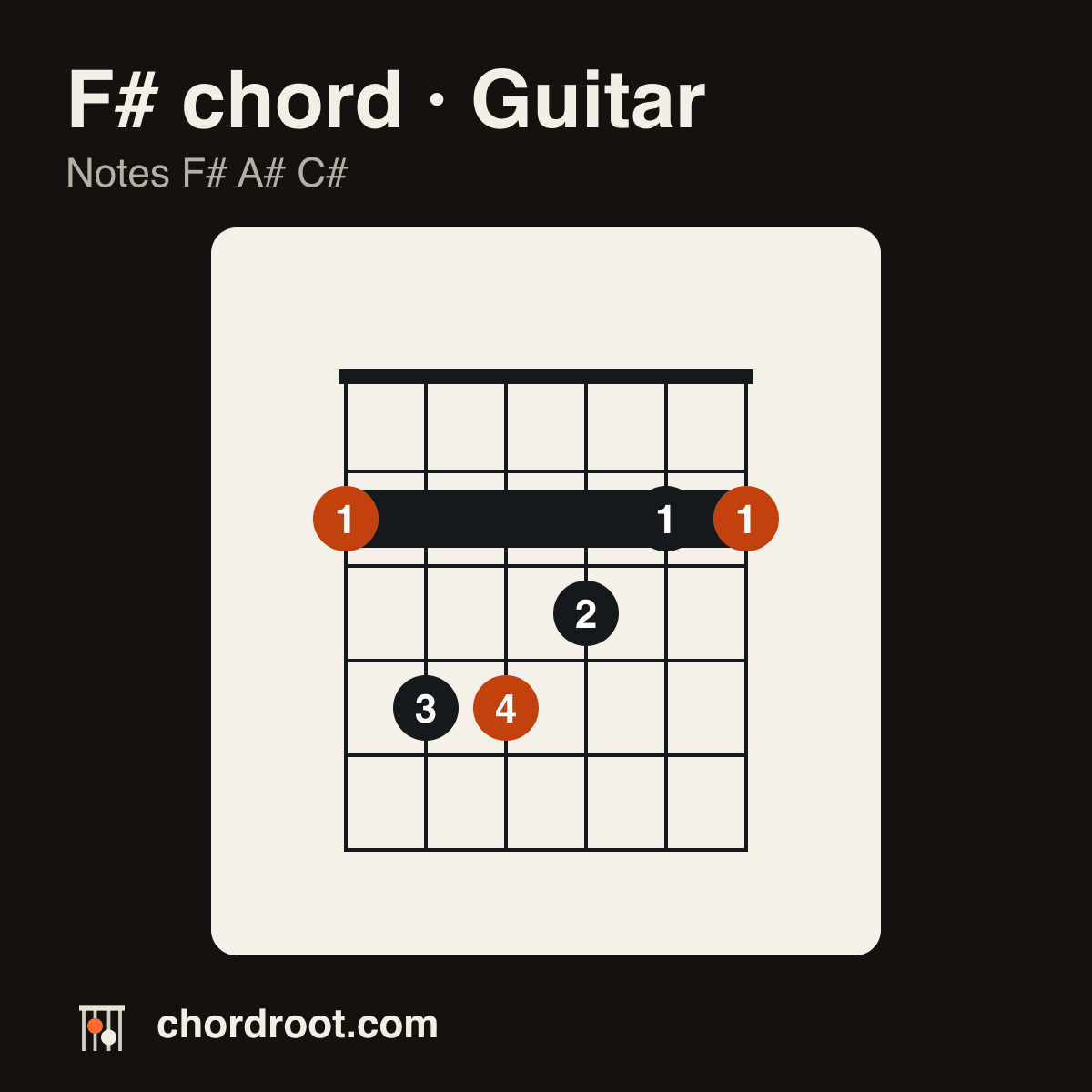
How to play the standard F# shape
Lay your index finger flat across fret 2, from the low E string to the high E string.
| Finger | String | Fret |
|---|---|---|
| index, barre | low E to high E | 2 |
| middle | G | 3 |
| ring | A | 4 |
| little | D | 4 |
What F# sounds like
F# sounds bright and stable because of its major third (A#).
It's the home chord of the key of F# major.
4 ways to play F#
F# has 4 shapes here, starting at frets 2, 2, 9 and 6.
- Standard244322low EF#AC#DF#GA#BC#high EF#
- No-barrexx4322low EmutedAmutedDF#GA#BC#high EF#
- x-9-11-11-11-9low EmutedAF#DC#GF#BA#high EC#
- x98676low EmutedAF#DA#GC#BF#high EA#
You'll hear F# on the D and low E strings with 244322, because that shape uses both strings.
Easiest changes from F#
Move from F# to B first. 1 finger stays in place, and E keeps no fingers there. For F# to C#, you won't keep any fingers in place.
Try the smaller changes first, then play C#, whose widest single finger movement spans 3 frets.
| Chord change | Shape or inversion | What moves |
|---|---|---|
F# to B | F# 244322 to B x24442 | 1 finger stays · index finger on high E string at fret 2 |
F# to C# | F# 244322 to C# x46664 | no finger stays · each finger moves up at most 3 frets |
F# to E | F# 244322 to E 022100 | no finger stays · each finger moves down at most 2 frets |
What's in F#
The F# formula is 1 3 5.
| Note | Degree | Role | Half steps from the root |
|---|---|---|---|
| F# | 1 | root | 0 |
| A# | 3 | major third | 4 |
| C# | 5 | fifth | 7 |
Keys with F#
The F# chord belongs to 3 major keys and 3 minor keys. Roman numerals give the chord's degree in each key, in upper case for major chords and lower case for minor ones.
| Key | Numeral | Function |
|---|---|---|
| Db major | IV | 4th degree, subdominant |
| F# major | I | 1st degree, tonic |
| B major | V | 5th degree, dominant |
| Eb minor | III | 3rd degree |
| G# minor | VII | 7th degree |
| Bb minor | VI | 6th degree |
In F# major, F# goes with G#m, A#m, B, C# and D#m. A common progression is I, V, vi, IV, played as F#, C#, D#m and B.
Questions about F#
- Is F# hard to play on guitar?
- Yes. It's one of the harder major chords, number 10 of 12.
Songs that use F#
8 songs on the site use F#, with the best known first.
- Jingle Bellskey of E, appears 2 times, in verses 1 and 2
- It Is Well With My Soulkey of Db, one of its main chords, appears 10 times, in every verse
- The Love of Godkey of Db, one of its main chords, appears 12 times, in every verse
- Beneath The Cross Of Jesuskey of Db, appears 5 times, in every verse
- Under His Wingskey of Db, one of its main chords, appears 3 times, in every verse
- If God Had Not Been on Our Sidekey of A, appears 3 times, in every verse
- Jesus Came, the Heavens Adoringkey of D, appears 5 times, in every verse
- Wexford Carolkey of Eb, one of its main chords, appears 25 times, in every verse
Compare F# with other chords
9 chords share the F# root and 11 chords are other major chords. The table runs from the smallest hand movement to the largest, starting from 244322. See all major chords.
| Chord | Relation | Shapes | Hand movement |
|---|---|---|---|
| F#7 | Same root, adds E | 244322 to 242322 | 3 fingers stay · index finger on low E string at fret 2 · middle finger on G string at fret 3 · ring finger on A string at fret 4 |
| F#maj7 | Same root, adds E# | 244322 to 243322 | 3 fingers stay · index finger on low E string at fret 2 · middle finger on G string at fret 3 · ring finger on A string at fret 4 |
| F#add9 | Same root, adds G# | 244322 to 244324 | 3 fingers stay · index finger on low E string at fret 2 · middle finger on G string at fret 3 · ring finger on A string at fret 4 |
| F#aug | Same root, drops C# and adds C## | 244322 to 254332 | 2 fingers stay · index finger on low E string at fret 2 · middle finger on G string at fret 3 |
| F#m | Same root, drops A# and adds A | 244322 to 244222 | 1 finger stays · index finger on low E string at fret 2 |
| F#m7 | Same root, drops A# and adds A and E | 244322 to 242222 | 1 finger stays · index finger on low E string at fret 2 |
| F#sus4 | Same root, drops A# and adds B | 244322 to 224422 | 1 finger stays · index finger on low E string at fret 2 |
| B | Same quality, root up 5 half steps | 244322 to x24442 | 1 finger stays · index finger on high E string at fret 2 |
| F#sus2 | Same root, drops A# and adds G# | 244322 to 246622 | 1 finger stays · index finger on low E string at fret 2 |
| F#dim | Same root, drops A# and C# and adds A and C | 244322 to xx4212 | 1 finger stays · little finger on D string at fret 4 |
| C | Same quality, root up 6 half steps | 244322 to x32010 | no finger stays · each finger moves down at most 1 fret |
| D | Same quality, root down 4 half steps | 244322 to xx0232 | no finger stays · each finger moves at most 1 fret |
| F | Same quality, root down 1 half step | 244322 to 133211 | no finger stays · slide the whole shape down 1 fret |
| G | Same quality, root up 1 half step | 244322 to 320003 | no finger stays · each finger moves at most 1 fret |
| Bb | Same quality, root up 4 half steps | 244322 to x13331 | no finger stays · each finger moves at most 1 fret |
| E | Same quality, root down 2 half steps | 244322 to 022100 | no finger stays · each finger moves down at most 2 frets |
| Ab | Same quality, root up 2 half steps | 244322 to 466544 | no finger stays · slide the whole shape up 2 frets |
| A | Same quality, root up 3 half steps | 244322 to x02220 | no finger stays · each finger moves at most 2 frets |
| C# | Same quality, root down 5 half steps | 244322 to x46664 | no finger stays · each finger moves up at most 3 frets |
| Eb | Same quality, root down 3 half steps | 244322 to x68886 | no finger stays · each finger moves up at most 5 frets |
F# on other instruments
The 3 notes, F#, A# and C#, stay the same on every instrument, but the shapes change.
What to learn after F#
Learn B next.
1 finger stays in place as you switch from F# to B. F# is also the relative major of D#m, with the same key signature.
After that, try C#, then E.